
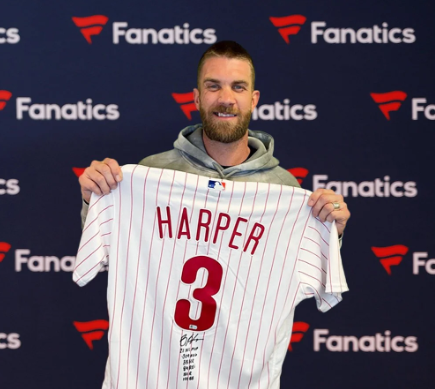
When a teenage boy graces the cover of Sports Illustrated with the headline “Baseball’s Chosen One,” the weight of expectation can crush even the most talented athlete. But Bryce Harper is no ordinary athlete. Born on October 16, 1992, in Las Vegas, Nevada, Harper has not only met those sky-high expectations — he has exceeded them in ways few could have imagined. Today, at 33 years old, he stands as one of the most decorated and compelling figures in Major League Baseball history, and his journey is far from over.
Early Life: A Prodigy Is Born
From the very beginning, Bryce Harper was different. He began swinging a bat almost before he could walk, and by his early teenage years, it was clear that he possessed a rare combination of raw power, sharp instincts, and an unmatched competitive fire. At just 16 years old, he appeared on the cover of Sports Illustrated — a moment that announced to the world that a superstar was about to arrive.
Harper was so advanced that he obtained his GED early and enrolled at the College of Southern Nevada, making himself eligible for the MLB Draft at 17. His gamble paid off immediately. In 2010, the Washington Nationals selected him with the very first overall pick in the draft — the most coveted selection in all of baseball. The hype was enormous, but Harper never shrank from it.
Rising to the Top: Washington Nationals Years (2012–2018)
Harper made his MLB debut on April 28, 2012, and wasted no time making an impression. He was named the National League Rookie of the Year, announced himself as a generational talent, and quickly became the face of the Washington Nationals franchise. Over his seven seasons in Washington, he earned six All-Star selections and established himself as one of the most feared hitters in the game.
His signature season came in 2015, when Harper put together one of the greatest offensive performances in modern baseball history. He batted .330 with 42 home runs and 99 RBIs, posted an extraordinary 1.109 OPS, and was named the National League Most Valuable Player unanimously. It was a season for the history books — a reminder that when Harper is fully healthy and locked in, he is simply on a different level than everyone else.
Despite individual brilliance, Harper and the Nationals fell short of a World Series title during his time in Washington. When his contract expired after the 2018 season, one of the most anticipated free agent decisions in baseball history was about to unfold.
A New Chapter: Philadelphia Phillies (2019–Present)
In March 2019, Bryce Harper signed a 13-year, $330 million contract with the Philadelphia Phillies — the largest contract in the history of North American professional sports at the time. The city of Philadelphia, known for its passionate and demanding fan base, welcomed Harper with both excitement and enormous expectation.
Harper delivered. He embraced the city, the fans, and the pressure like only he could. In 2021, he won his second NL MVP award, slashing .309/.429/.615 with 35 home runs. It was a performance that silenced any doubters and reaffirmed his status as one of baseball’s elite players.
Then came one of the most remarkable chapters of his career. During the 2022 postseason, Harper played through a torn UCL in his elbow, delivering a legendary performance including a go-ahead two-run home run in Game 5 of the NLCS against the San Diego Padres — a moment that sent the Phillies to the World Series. He was named the NLCS MVP. It was the kind of clutch heroism that legends are built upon.
Following the 2022 season, Harper underwent Tommy John surgery — a procedure that required an extended recovery. Rather than rush back to the outfield, he transitioned permanently to first base, extending the life of his career while continuing to produce at an elite level.
Resilience in the Face of Adversity
Harper’s career has not been without its challenges. Injuries have tested him repeatedly — from his elbow surgery to a wrist injury in 2025 that limited him to 132 games. During that season, he posted a .261 batting average with 27 home runs and an .844 OPS, numbers that were considered a “down year” by his standards. That itself speaks volumes about how consistently brilliant he has been throughout his career.
Despite the dip, his underlying metrics told a different story. His hard-hit rate ranked in the top quarter of the entire league, and his expected weighted on-base average placed him in the 91st percentile. Harper remains a dangerous and productive hitter who simply refuses to let his body define his output.
Hall of Fame Bound
As of 2026, Bryce Harper has accumulated 1,831 hits and 369 home runs in his MLB career. He sits 169 hits away from 2,000 and 31 home runs away from the prestigious 400-home-run milestone — two numbers that would cement his Hall of Fame legacy beyond any reasonable doubt.
His resume already speaks for itself: two NL MVP awards, eight All-Star selections, an NL Rookie of the Year, four Silver Slugger Awards, an NLCS MVP, and a career OPS north of .900. He became just the 14th player in MLB history to reach 1,000 RBIs, 1,000 runs, and 1,000 walks before turning 33 years old — and 11 of those 14 players are already in Cooperstown.
Looking Ahead: 2026 and Beyond
Harper enters the 2026 season with renewed energy and motivation. He recently committed to representing Team USA in the 2026 World Baseball Classic — an opportunity he missed in 2023 while recovering from surgery. Alongside stars like Aaron Judge, Paul Scenes, and Bobby Witt Jr., Harper will don the red, white, and blue and chase glory on the international stage.
Back with the Phillies, Harper has expressed interest in competing in the 2026 Home Run Derby, which will be held at Citizens Bank Park — his home stadium. Winning the derby in front of his own fans, in his own city, would be the kind of storybook moment that Harper’s career seems destined to produce.
Conclusion: More Than a Ballplayer
Bryce Harper is more than a baseball player. He is a cultural phenomenon — a throwback to the era of larger-than-life sports personalities who don’t just play the game but define it. From the cover of Sports Illustrated at 16 to a potential Hall of Fame plaque in Cooperstown, his journey is one of relentless drive, extraordinary talent, and the courage to carry impossibly high expectations with a smile.
The best may still be yet to come. And in baseball, very few things are more exciting than that.
