
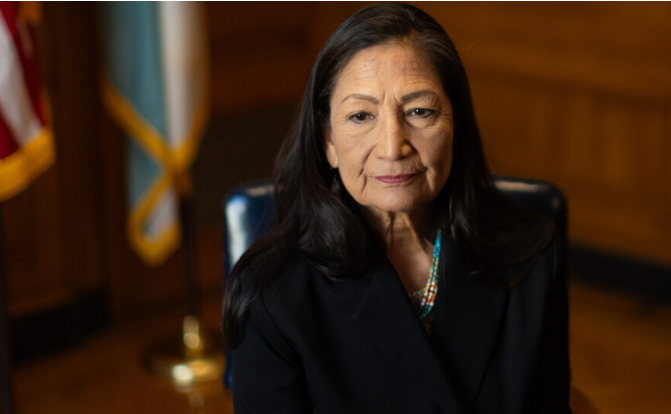
Deb Haaland’s story is one of the most remarkable in modern American politics. She has gone from struggling single mother to a member of Congress, to a U.S. Cabinet secretary, and now to a candidate who could become the first Native American woman ever elected governor of a U.S. state. Her journey reflects both personal resilience and a broader shift in American political representation.
Early Life and Background
Debra Anne Haaland was born on December 2, 1960, in Winslow, Arizona. She is an enrolled member of the Laguna Pueblo tribe, a Native American community with deep roots in New Mexico. Haaland often describes herself as a 35th-generation New Mexican, since the Pueblo people have lived on that land since the 1200s.
Her mother, Mary Toya, served in the United States Navy and later worked for the Bureau of Indian Affairs. Her father, Major John David “Dutch” Haaland, was a Marine Corps officer who earned the Silver Star for his service in Vietnam. Growing up in a military family meant constant moving. Haaland attended 13 different public schools before her family finally settled in Albuquerque, where she eventually graduated from Highland High School.
Life was not easy for Haaland in her young adulthood. According to reporting on her background, she experienced periods of homelessness and struggled with alcohol addiction before turning her life around. As a single mother, she relied on federal food assistance to get by. To support her family, she sold homemade salsa and took on custodial work at her child’s preschool just to help cover tuition costs. These early struggles would later become a central part of her political identity, giving her a personal connection to the economic hardships many New Mexicans face.
A Career in New Mexico Politics
Haaland’s political career began at the state level. She served as chair of the Democratic Party of New Mexico from 2015 to 2017, a period during which Democrats regained control of the state House and the office of secretary of state. She is credited with stabilizing the party’s finances, having raised enough money to pay off years of accumulated debt left by previous leadership.
In 2018, Haaland set her sights on national office, running for New Mexico’s 1st Congressional District seat, which covers most of Albuquerque and its suburbs. She won the Democratic primary with about 40.5 percent of the vote, carrying every county in the district. That November, she made history. Along with Sharice Davids of Kansas, Haaland became one of the first two Native American women ever elected to the United States Congress.
As a representative, Haaland built a reputation as one of the more progressive voices in the House. During her freshman term, she co-sponsored more bills than any other newly elected member of Congress and built one of the most liberal voting records in the chamber, according to The New Yorker. In March 2019, she made history again by becoming the first Native American woman to preside over the U.S. House of Representatives during a floor debate. She also stepped onto the national political stage as one of the co-chairs of Senator Elizabeth Warren’s 2020 presidential campaign.
Secretary of the Interior
Haaland’s most prominent role before her current campaign came when President-elect Joe Biden announced in December 2020 that he would nominate her to serve as Secretary of the Interior. The Senate confirmed her in March 2021 by a vote of 51 to 40, making her the first Native American to ever hold a Cabinet secretary position in U.S. history.
As head of the Interior Department, Haaland oversaw a massive federal agency responsible for managing public lands, national parks, and the country’s relationship with tribal nations. She has described her tenure as one focused on repairing morale within the department and emphasizing the protection of natural resources. She served in the role for the entirety of Biden’s four-year term, managing a workforce of roughly 70,000 employees and an annual budget of about $18 billion.
Running for Governor of New Mexico
After leaving the Biden administration, Haaland set her sights on the highest office in her home state. She officially launched her campaign for governor of New Mexico in February 2025, becoming the first major candidate to enter the race to succeed term-limited Governor Michelle Lujan Grisham.
Haaland’s campaign has centered on what she calls an “affordability agenda.” Her platform, dubbed “Deb’s Plan,” is built around four main pillars: education, affordability, health care, and public safety. Among her specific promises are raising the state’s minimum wage, creating long-term savings accounts for babies born in New Mexico, and launching a multilingual tax credit calculator for residents. She has also pledged to ban “rent fixing,” a practice in which landlords use artificial intelligence tools to adjust monthly rents, and to restrict how much housing private equity firms can own across the state.
In interviews, Haaland has spoken about the importance of Native representation in government, describing herself first and foremost as a Pueblo woman. She often draws on her grandmother’s experience growing up without running water or electricity until the 1970s to explain why she understands the daily struggles many New Mexico families still face.
Polling ahead of the Democratic primary showed Haaland with a strong lead, with one Emerson College survey from April 2026 putting her ahead of Bernalillo County District Attorney Sam Bregman by a margin of 40 percent to 24 percent. That lead held. On June 2, 2026, Haaland won the Democratic nomination for governor, defeating Bregman and securing her spot in the November general election. She will face Republican nominee Gregg Hull in that race.
A Potentially Historic Election
If Haaland wins in November, she will become the first Native American woman ever to serve as a state governor in American history. Her campaign has leaned into this historic possibility, running advertisements in the Diné language and highlighting her ancestral ties to the region.
Haaland has also framed her candidacy around frustration with federal policy, arguing that New Mexicans are feeling the negative effects of Trump administration decisions, particularly cuts affecting Medicaid and food assistance programs that the state relies on heavily.
For supporters, Haaland represents both continuity with the outgoing Democratic administration and the chance to elect the state’s first Native American governor. For her opponents, the race will likely center on debates over the economy, public safety, and the direction of state policy in a fast-changing political environment.
Whatever the outcome in November, Deb Haaland’s path from a struggling single mother in Albuquerque to a potential governor’s office reflects a personal story of resilience that has shaped much of her public identity — and a broader story about expanding political representation in the United States.
